blah blah balh balh
Tuesday, February 10, 2015


Thursday, September 4, 2014
Rot from the Sepulchre
Once again the American criminal justice system parades its wretched excrescences before the world. It was reported yesterday that DNA evidence cleared two black men of a rape and murder which they did not commit and for which they spent 30 years behind bars.
How did the “best justice system in the world” allow this to happen? There are two reasons.
The first reason is so worn as to be trite. The defendants were Negroes and therefore presumptively suspect. They were arrested on the alleged tip of an undisclosed informant passing along high school rumors. Fingerprint evidence from the scene of the crime was never examined and its existence was kept secret from the defense. In short, they were framed by a police force which, throughout the country, has proved itself to be consistently racist and corrupt.
But how was it that this flimsy case survived the “crucible of adversarial testing” before a “jury tried and true” in a trial governed by the very highest principles of Due Process of Law, inherited from Magna Carta and reaffirmed for generations by courts zealous to protect the interests and God-given freedoms of the individual?
Simple: The defendants confessed and that was that.
However, this occurred in 1983. Surely the suspects were advised of their Miranda Rights. Surely indeed, which brings us to the stinking core of the heap: Miranda was designed to save the confession not to protect the individual.
As everyone knows, Miranda v. Arizona (1966) 384 U.S. 436 required police to inform arrested suspects of their Constitutional rights prior to any questioning. The arrested person must be told that he has a right to remain silent; that he is entitled to a lawyer of his choosing or paid for by the State and that he can refuse to answer questions at any time. What could be more fair?
If, after being so advised, a suspect then chooses to ‘fess up that is his choice. The State has done what constitutional decency requires and it can hardly be expected to now ignore incriminating information freely and voluntarily provided!
This is the sort of high-sounding flatulence the United States inherited from English judges along with Magna Carta.
Why give warnings at all? Because as the Supreme Court found in the Miranda Case, custodial interrogation is “inherently coercive.” (Id., at 467, 515, 528, 535.) Those two words are worth pondering.
Anyone who has ever been pulled over for so much as a speeding ticket certainly knows the feeling. It is not pleasant. It is stressful. It causes the mind to race ahead thinking about too many things and therefore about none of them very well. Imagine then being handcuffed, walked into a cell and cut off from the world. Deprived of liberty it is animal and human nature to freak. Being taken into custody is at least inherently stressful.
But it is worse. A person who is taken into custody looses his freedom and not in some abstract or theoretical way. He cannot move his hands where he wills. He cannot walk where he will. He cannot access the phone or the urinal without asking permission from someone who has complete control over his immediate existence. That is what being in custody means. How can anything be considered “free and voluntary” in such a situation? If you are in custody you are not free. One would think that was obvious.
Nor voluntary. The word “voluntary” means “unconstrained by the interference of another; unimpelled by the influence of another; not prompted or persuaded by another; done of his or its own accord; spontaneous; acting of one's self, or of itself; free.” (Webster's Revised Unabridged Dictionary (1913), p. 1618.)
A person in custody knows that the police, at the very least, suspect of him a crime and have the power to prosecute him should they choose to do so. This presents an ultimate risk of being sent to prison. Even more immediately it presents the more imminent prospect of being locked up pending trial, of loosing one’s job, of having one’s whole life turned inside out and ransacked by a decision that is, in the first instance, entirely up to the arresting officer or detective who takes over the case.
Thus, in addition to loosing his physical freedom and his contact with outside resources, the arrested person is placed under extreme duress by the prospects and alternatives faced. His situation is circumscribed and constrained by another. Like a dog, he will constantly be responding and adjusting himself to the person who can “make things go worse” for him.
All this is what “inherently coercive” means, which means that legally speaking no statement given in custody could possibly be considered “free and voluntary.” Howsoever viewed, to think otherwise is an oxymoron. The Supreme Court in Miranda recognized this, said this and cited studies on the psychological impact of being taken into custody.
Oh... but me oh my, what are we to do without a confession? Are we to forgo the apple of conviction “merely” because the confession was “situationally” coerced? After all, it could be true and a trial is “the pursuit of truth.”
So, rather than require the police to come up with independent evidence of the crime, the Court came up with a Marvellous Solution, one that was as Anglo-American as the Playing Fields of Eton .... or Andover. We can, the Court intoned, redress the coerciveness of the situation and “balance the playing field” by requiring the police to advise the suspect of his rights and the freedoms he retains, as a matter of law, even while in custody!
Let it not be said that the Constitution stops at the cell door! Nay! Fie! Even suspected of the most foul wrong doing, the individual retains his precious, inalienable rights.
What kind of imbecile could come up with such a solution?
Actually, these “advisements” were first enacted by a statute of Queen Victoria (11 & 12 Vict. c. 42, § 18) which required a person subpoenaed to a magistrate’s inquest to be advised of his right to silence, viz:
But there is a whale of a difference between advisement by a judicial officer, in court, upon mere summons and advisement by the burly brute who just threw you against a wall, cuffed your hands and generally manhandled you into a cell where you will stay until and if he lets you out.
More critically, the referenced advisement ensued after having heard and being presented with the prosecution’s evidence. In other words, the statute presupposed that there was something more than an accusation to make the case.
Did the Supreme Court really not see the difference? Did they really and truly think they could “balance the playing field” at the police station? Were they such terminal preppies?
Of course not. The Court was well aware of existing literature on the matter which its own precedents had cited. One can at least assume that Supreme Court judges understand the English words they use; and “inherent” means: permanently existing in something; inseparably attached or connected; naturally pertaining to; innate; inalienable;...”
If custodial interrogation is “inherently coercive” that means compulsion is indelible to and inseverable from the situation. It cannot be cured by an “advisement” ... particularly from the person who just probably punched you in the gut and ran through the words of the warnings quickly, sarcastically and in a tone of voice which said: “and God help your sorry moutha fuckin ass if you “choose” to play hardball, asshole.”
The U.S. public, ever ignorant and belligerent, abetted by a chronically stupid, insipid and scandal-mongering press, are convinced that the Miranda decision was bleeding heart liberal judicial activism aimed at shackling the police and coddling criminals.
Just the reverse is true: Miranda was judicial activism aimed at “saving the confession” in order to insure conviction while providing some pretty window dressing to prove just how much and how deeply we cared for Due Process.
But surely there are other legal safeguards which forestall the possibility of a person being convicted solely on the basis of a confession which might possibly, in spite of all our best safeguards, be the result of some psychological process that makes an unfortunate person “the deluded instrument of his own conviction."
Yes indeed! It is known as the corpus delicti rule. Before a confession can be admitted, there must be proof that the crime charged was committed. This ancient and hoary rule serves the fundamentally important purpose of insuring sure that a crime is not invented by the police or contrived or imagined by the defendant himself.
No! No! A man cannot simply walk into a police station and confess to killing a cat without there being independent proof that a cat was killed. The corpus delicti rule insures that a man will “never be convicted on the strength of his confession alone.”
But of course —- and this is said with a completely straight face — proof that a crime was committed does not require proof of the perpetrator’s identity. “Identity is not part a crime’s corpus.”
In other words, if there is proof that a cat was killed in Montana, it is sufficient for conviction that a man in New York says “I did it.” Let it not be said that American law rushes to convict “solely” on the strength of a confession!
Of course a crime was committed. A rule which seeks to prevent conviction upon entirely unsubstantiated accusations sets the bar so low as to be worthless. The critical issue is always the identity of the perpetrator. The corpus delicti rule insures nothing and permits the most critical and essential part of the case to be supplied entirely by three words from the accused’s mouth.
This is the kind of garbage that passes for Due Process in the United States of America, and it was on the basis of this garbage that the two innocent black men were convicted of a rape and murder they admitted to but did not commit.
Well, one might ask, why did they admit it? Because nothing in Miranda prevents the cops from tipping the field once they have leveled it for all of 30 seconds.
Nothing in Miranda prevents interrogations lasting for hours; interrogations after being awoken in the middle of the night; Mutt and Jeff routines, lies, insinuations, and an arsenal of tricks and devices conjured up by government psychologists and experts in “cracking” suspects.
Once the warnings have been run-n-mumbled through... let all out psych war begin! And like imperial Caesars at the games, the Supreme Court has smiled on the sorry spectacle.
Not only were the two black teenagers subject to a “relentless” interrogation that lasted for hours it also turned out that they were mentally disabled. One of them could barely write.
But in the lofty reaches of Supreme Court jurisprudence that does change a thing. So long as the suspect was capable of understanding the words spoken, he is presumed, as a matter of law, to understand the nature and implication of the rights as to which he has been advised.
Even an illegal immigrant, who speaks a bare minimum of English and who has absolutely no contextual awareness of how the judicial system works or the role of the police in it, has been held to “sufficiently” understand the Miranda warning thus “preserving” his confession for use at trial.

How did the “best justice system in the world” allow this to happen? There are two reasons.
The first reason is so worn as to be trite. The defendants were Negroes and therefore presumptively suspect. They were arrested on the alleged tip of an undisclosed informant passing along high school rumors. Fingerprint evidence from the scene of the crime was never examined and its existence was kept secret from the defense. In short, they were framed by a police force which, throughout the country, has proved itself to be consistently racist and corrupt.
But how was it that this flimsy case survived the “crucible of adversarial testing” before a “jury tried and true” in a trial governed by the very highest principles of Due Process of Law, inherited from Magna Carta and reaffirmed for generations by courts zealous to protect the interests and God-given freedoms of the individual?
Simple: The defendants confessed and that was that.
However, this occurred in 1983. Surely the suspects were advised of their Miranda Rights. Surely indeed, which brings us to the stinking core of the heap: Miranda was designed to save the confession not to protect the individual.
As everyone knows, Miranda v. Arizona (1966) 384 U.S. 436 required police to inform arrested suspects of their Constitutional rights prior to any questioning. The arrested person must be told that he has a right to remain silent; that he is entitled to a lawyer of his choosing or paid for by the State and that he can refuse to answer questions at any time. What could be more fair?
If, after being so advised, a suspect then chooses to ‘fess up that is his choice. The State has done what constitutional decency requires and it can hardly be expected to now ignore incriminating information freely and voluntarily provided!
This is the sort of high-sounding flatulence the United States inherited from English judges along with Magna Carta.
Why give warnings at all? Because as the Supreme Court found in the Miranda Case, custodial interrogation is “inherently coercive.” (Id., at 467, 515, 528, 535.) Those two words are worth pondering.
Anyone who has ever been pulled over for so much as a speeding ticket certainly knows the feeling. It is not pleasant. It is stressful. It causes the mind to race ahead thinking about too many things and therefore about none of them very well. Imagine then being handcuffed, walked into a cell and cut off from the world. Deprived of liberty it is animal and human nature to freak. Being taken into custody is at least inherently stressful.
But it is worse. A person who is taken into custody looses his freedom and not in some abstract or theoretical way. He cannot move his hands where he wills. He cannot walk where he will. He cannot access the phone or the urinal without asking permission from someone who has complete control over his immediate existence. That is what being in custody means. How can anything be considered “free and voluntary” in such a situation? If you are in custody you are not free. One would think that was obvious.
Nor voluntary. The word “voluntary” means “unconstrained by the interference of another; unimpelled by the influence of another; not prompted or persuaded by another; done of his or its own accord; spontaneous; acting of one's self, or of itself; free.” (Webster's Revised Unabridged Dictionary (1913), p. 1618.)
A person in custody knows that the police, at the very least, suspect of him a crime and have the power to prosecute him should they choose to do so. This presents an ultimate risk of being sent to prison. Even more immediately it presents the more imminent prospect of being locked up pending trial, of loosing one’s job, of having one’s whole life turned inside out and ransacked by a decision that is, in the first instance, entirely up to the arresting officer or detective who takes over the case.
Thus, in addition to loosing his physical freedom and his contact with outside resources, the arrested person is placed under extreme duress by the prospects and alternatives faced. His situation is circumscribed and constrained by another. Like a dog, he will constantly be responding and adjusting himself to the person who can “make things go worse” for him.
"The human mind, under the pressure of calamity, is easily seduced, and is liable, in the alarm of danger, to acknowledge indiscriminately a falsehood or a truth, as different agitations may prevail. A confession, therefore, whether made upon an official examination or in discourse with private persons, which is obtained from a defendant, either by the flattery of hope, or by the impressions of fear, however slightly the emotions may be implanted, is not admissible evidence; for the law will not suffer a prisoner to be made the deluded instrument of his own conviction." (Hawkins' Pleas of the Crown (6th ed., by Leach -- published in 1787, book 2, chapter 46, section 3, cited in Bram v. United States (1897) 168 U.S. 532, 547.)
All this is what “inherently coercive” means, which means that legally speaking no statement given in custody could possibly be considered “free and voluntary.” Howsoever viewed, to think otherwise is an oxymoron. The Supreme Court in Miranda recognized this, said this and cited studies on the psychological impact of being taken into custody.
Oh... but me oh my, what are we to do without a confession? Are we to forgo the apple of conviction “merely” because the confession was “situationally” coerced? After all, it could be true and a trial is “the pursuit of truth.”
So, rather than require the police to come up with independent evidence of the crime, the Court came up with a Marvellous Solution, one that was as Anglo-American as the Playing Fields of Eton .... or Andover. We can, the Court intoned, redress the coerciveness of the situation and “balance the playing field” by requiring the police to advise the suspect of his rights and the freedoms he retains, as a matter of law, even while in custody!
Let it not be said that the Constitution stops at the cell door! Nay! Fie! Even suspected of the most foul wrong doing, the individual retains his precious, inalienable rights.
What kind of imbecile could come up with such a solution?
Actually, these “advisements” were first enacted by a statute of Queen Victoria (11 & 12 Vict. c. 42, § 18) which required a person subpoenaed to a magistrate’s inquest to be advised of his right to silence, viz:
"Having heard the evidence, do you wish to say anything in answer to the charge? You are not obliged to say anything unless you desire to do so, but whatever you say will be taken down in writing, and may be given in evidence against you upon your trial."
But there is a whale of a difference between advisement by a judicial officer, in court, upon mere summons and advisement by the burly brute who just threw you against a wall, cuffed your hands and generally manhandled you into a cell where you will stay until and if he lets you out.
More critically, the referenced advisement ensued after having heard and being presented with the prosecution’s evidence. In other words, the statute presupposed that there was something more than an accusation to make the case.
Did the Supreme Court really not see the difference? Did they really and truly think they could “balance the playing field” at the police station? Were they such terminal preppies?
Of course not. The Court was well aware of existing literature on the matter which its own precedents had cited. One can at least assume that Supreme Court judges understand the English words they use; and “inherent” means: permanently existing in something; inseparably attached or connected; naturally pertaining to; innate; inalienable;...”
If custodial interrogation is “inherently coercive” that means compulsion is indelible to and inseverable from the situation. It cannot be cured by an “advisement” ... particularly from the person who just probably punched you in the gut and ran through the words of the warnings quickly, sarcastically and in a tone of voice which said: “and God help your sorry moutha fuckin ass if you “choose” to play hardball, asshole.”
The U.S. public, ever ignorant and belligerent, abetted by a chronically stupid, insipid and scandal-mongering press, are convinced that the Miranda decision was bleeding heart liberal judicial activism aimed at shackling the police and coddling criminals.
Just the reverse is true: Miranda was judicial activism aimed at “saving the confession” in order to insure conviction while providing some pretty window dressing to prove just how much and how deeply we cared for Due Process.
"This Court, while protecting individual rights, has always given ample latitude to law enforcement agencies in the legitimate exercise of their duties. The limits we have placed on the interrogation process should not constitute an undue interference...." (Miranda, supra, at p. 481.)
But surely there are other legal safeguards which forestall the possibility of a person being convicted solely on the basis of a confession which might possibly, in spite of all our best safeguards, be the result of some psychological process that makes an unfortunate person “the deluded instrument of his own conviction."
Yes indeed! It is known as the corpus delicti rule. Before a confession can be admitted, there must be proof that the crime charged was committed. This ancient and hoary rule serves the fundamentally important purpose of insuring sure that a crime is not invented by the police or contrived or imagined by the defendant himself.
No! No! A man cannot simply walk into a police station and confess to killing a cat without there being independent proof that a cat was killed. The corpus delicti rule insures that a man will “never be convicted on the strength of his confession alone.”
But of course —- and this is said with a completely straight face — proof that a crime was committed does not require proof of the perpetrator’s identity. “Identity is not part a crime’s corpus.”
In other words, if there is proof that a cat was killed in Montana, it is sufficient for conviction that a man in New York says “I did it.” Let it not be said that American law rushes to convict “solely” on the strength of a confession!
Of course a crime was committed. A rule which seeks to prevent conviction upon entirely unsubstantiated accusations sets the bar so low as to be worthless. The critical issue is always the identity of the perpetrator. The corpus delicti rule insures nothing and permits the most critical and essential part of the case to be supplied entirely by three words from the accused’s mouth.
This is the kind of garbage that passes for Due Process in the United States of America, and it was on the basis of this garbage that the two innocent black men were convicted of a rape and murder they admitted to but did not commit.
Well, one might ask, why did they admit it? Because nothing in Miranda prevents the cops from tipping the field once they have leveled it for all of 30 seconds.
Nothing in Miranda prevents interrogations lasting for hours; interrogations after being awoken in the middle of the night; Mutt and Jeff routines, lies, insinuations, and an arsenal of tricks and devices conjured up by government psychologists and experts in “cracking” suspects.
Once the warnings have been run-n-mumbled through... let all out psych war begin! And like imperial Caesars at the games, the Supreme Court has smiled on the sorry spectacle.
Not only were the two black teenagers subject to a “relentless” interrogation that lasted for hours it also turned out that they were mentally disabled. One of them could barely write.
But in the lofty reaches of Supreme Court jurisprudence that does change a thing. So long as the suspect was capable of understanding the words spoken, he is presumed, as a matter of law, to understand the nature and implication of the rights as to which he has been advised.
Even an illegal immigrant, who speaks a bare minimum of English and who has absolutely no contextual awareness of how the judicial system works or the role of the police in it, has been held to “sufficiently” understand the Miranda warning thus “preserving” his confession for use at trial.
It was racism that framed the two brothers and brought them to trial but it was rot from the white-washed sepulcher that allowed them to be unjustly convicted.
©justinlaw, 2014
Monday, February 17, 2014
Reasonable Wrongness
Somewhat like an alarm going off in the smouldering remains of a fire, the Supreme Court’s decision in Heien v. North Carolina, upholding a search incident to a broken tail-light, has set off a flurry of public criticism.
Notwithstanding vociferous exasperation from some quarters in the media, the Court’s ruling had nothing to do with Justice Scalia’s subservience to corporate interests. It was rather the putrid fruit of a poisonous jurisprudence.
North Carolina law requires a vehicle to have “a stop lamp” (nowadays called a tail-light). Heien’s vehicle had two, one of which was not working. The essence of the Court’s decision was that even though Mr. Heien had done nothing wrong his stop, detention and search were nevertheless lawful.
It always helps to begin at the beginning of things which, in the law’s case, is English.
Notwithstanding vociferous exasperation from some quarters in the media, the Court’s ruling had nothing to do with Justice Scalia’s subservience to corporate interests. It was rather the putrid fruit of a poisonous jurisprudence.
North Carolina law requires a vehicle to have “a stop lamp” (nowadays called a tail-light). Heien’s vehicle had two, one of which was not working. The essence of the Court’s decision was that even though Mr. Heien had done nothing wrong his stop, detention and search were nevertheless lawful.
It always helps to begin at the beginning of things which, in the law’s case, is English.
.jpg) |
| Charles Pratt, 1st Earl of Camden from whose decision in Entick v Carrington the Fourth Amendement derives |
The American distaste for prepositional clauses leads them to think that in order to arrest someone there has to be “probable cause”. Not so. Non-use of prepositional clauses turns hard thinking into mush. In order for a search or seizure to take place there must be probable cause to believe that a crime has been or is being committed.
Once it is understood what probable cause really is, the wretched absurdity of the Court’s decision unfolds as if unto a bowl.
How is it possible for there to be probable cause to believe a crime was committed when what was observed was not a crime at all? It isn’t. To say otherwise, is goobledygook, with emphasis on the “gook.”
How did the Supreme Court get itself to swallow this gook? It did so by driving a truck the wrong way through the tunnel of the word “believe”.
The right of the people to be secure in their persons, houses, papers, and effects, against unreasonable searches and seizures, shall not be violated, and no Warrants shall issue, but upon probable cause, supported by Oath or affirmation, and particularly describing the place to be searched, and the persons or things to be seized.
For at least a century and a half after it was written, the Fourth Amendment was understood to require a warrant and probable cause before an arrest or search could be undertaken. In other words, the word “reasonable” was understood to be contextually defined and limited by the ensuing clauses. “Reasonable” meant having a warrant and probable cause.
In 1925, in Carrol v. United States (1925) U.S., 267 U.S. 132 the Supreme Court held that it wasn’t always necessary to have a warrant so long as there had been probable cause for the search.
It will be noted that this abbreviated way of speaking -- which substitutes the phrase “for the search” for “to believe a crime has been committed, thereby warranting a search” -- runs the risk of altering the constitutional context unless one remembers precisely that which has been skipped over.
That said, the Carrol decision did not alter the long understood rule that “reasonable” meant having probable cause to believe a crime was committed.
In 1925, in Carrol v. United States (1925) U.S., 267 U.S. 132 the Supreme Court held that it wasn’t always necessary to have a warrant so long as there had been probable cause for the search.
It will be noted that this abbreviated way of speaking -- which substitutes the phrase “for the search” for “to believe a crime has been committed, thereby warranting a search” -- runs the risk of altering the constitutional context unless one remembers precisely that which has been skipped over.
That said, the Carrol decision did not alter the long understood rule that “reasonable” meant having probable cause to believe a crime was committed.
Then came Rehnquist. This man, joined by other early proponents of the national security police state, had a deep and abiding antipathy toward the Fourth, Sixth and Eighth amendments. Under Rehnquist’s guidance the word "reasonable" became decoupled from the rest of the Fourth Amendment.
This decoupling contravened all canons of statutory or constitutional construction. If the warrant and probable cause clauses had nothing to do with the constitutional requirements for a search why bother stating them at all? It would suffice to simply have written: “The right of the people to be secure in their persons, houses, papers, and effects, against unreasonable searches and seizures, shall not be violated [.]"
However, it is axiomatic that all words in a statute or provision must be given effect. If a court can ignore part of a sentence or paragraph why bother with written statutes and laws at all?
This decoupling contravened all canons of statutory or constitutional construction. If the warrant and probable cause clauses had nothing to do with the constitutional requirements for a search why bother stating them at all? It would suffice to simply have written: “The right of the people to be secure in their persons, houses, papers, and effects, against unreasonable searches and seizures, shall not be violated [.]"
However, it is axiomatic that all words in a statute or provision must be given effect. If a court can ignore part of a sentence or paragraph why bother with written statutes and laws at all?
The Supreme Court’s decoupling of the word “reasonable” from the rest of the amendment simply erased one half of the constitutional guarantee. The Fourth Amendment was there but it was there for show and for optional use. It established no constitutional standard.
The situation was even worse because along with this decoupling the Court lowered the standard of proof from “probable cause” to “reasonable suspicion.” (See Terry v. Ohio (1968) 392 U.S. 1) That is another story not germane to the present issue; for, in the context of the Heien case, the question still remains “reasonable suspicion” of what?
The situation was even worse because along with this decoupling the Court lowered the standard of proof from “probable cause” to “reasonable suspicion.” (See Terry v. Ohio (1968) 392 U.S. 1) That is another story not germane to the present issue; for, in the context of the Heien case, the question still remains “reasonable suspicion” of what?
Anglo-American jurists think that “reasonableness” is some sort of sacred totem that solves all problems. Actually it is simply a malleable weasel word. “Reasonable” simply means: does it sound, sit and feel more or less sensible, common sensical, practical, maybe even a tad logical.
The sheer gooeyness of the word “reasonable” has troubled the Court which is why (since the advent of Rehnquist) it cobbled up the term objective reasonableness.
The sheer gooeyness of the word “reasonable” has troubled the Court which is why (since the advent of Rehnquist) it cobbled up the term objective reasonableness.
The notion is that whatever “reasonableness” might be exactly it is to be measured “objectively” by known, observable existing hard facts of some sort, which other people can see and assess for themselves. In other words, we are not wandering into the nether world of the Erlkonig (a fantasy goblin said to inhabit German forests).
Ah, but we are! The phrase “objective reasonableness” is a pleanosm — a redundancy which corrodes if it does not actually destroy the word modified. What is non-objective or "subjective reasonableness”? Insanity?
"But of all these books there were none he liked so well as those of the famous Feliciano de Silva's compositions. Their lucidity of style and complicated conceits were as pearls in his sight, particularly when in his reading he came upon courtships and cartels, where he often found passages like "the reason of the unreason with which my reason is afflicted so weakens my reason that with reason I murmur at your beauty;" ... (Don Quixote de La Mancha Ch. 1. )
Should we really have to worry about the interior “reasons” of a lunatic? And is the constitutional standard for a search or seizure simply that it not be outright insane?
 |
| The Reasons of his Unreason |
Indeed yes, because what the Supreme Court has now held is that the subjective but erroneous beliefs of the arresting officer are constitutionally reasonable. In other words, it has twisted probable cause into a subjective belief without objective correlative.
It must be remembered that the single broken tail-light was not “objectively” a crime in North Carolina, whether the officer thought so or not.
The Court’s decision does not destroy the Fourth Amendment — that has already been done — it simply opens the way for complete total police arbitrariness without recourse to law.
-oOo-
The second wretchedness of the Heien decision is actually the poisoned fruit of liberal jurisprudence
For years it was understood that an unconstitutional act was ultra vires. That is fancy Latin for “beyond the pale” or “in the outer darkness.”
Let me explain. The Constitution defines a reality in which we wish to exist. It is an ideal, but it is an ideal which we — by our daily actions — bring into actual being by our observance of it. The U.S. Constitution is fundamentally an ontological document.
Thus, an act that was unconstitutional was deemed “outside” the pale and, being so, simply did not exist in contemplation of law — that is, in the ideality of the Constitution and its bounden actualization by us. It followed that if an act was unconstitutional it could not, by that same contemplation, being given any force and effect. It was a nullity.
The Exculsionary Rule — disallowing the use at trial of illegally garnered evidence — followed ineluctably. If a search or seizure contravened the Fourth Amendment its fruits could not be given any effect because to do so would be to accept what was not acceptable.
For years it was understood that an unconstitutional act was ultra vires. That is fancy Latin for “beyond the pale” or “in the outer darkness.”
Let me explain. The Constitution defines a reality in which we wish to exist. It is an ideal, but it is an ideal which we — by our daily actions — bring into actual being by our observance of it. The U.S. Constitution is fundamentally an ontological document.
Thus, an act that was unconstitutional was deemed “outside” the pale and, being so, simply did not exist in contemplation of law — that is, in the ideality of the Constitution and its bounden actualization by us. It followed that if an act was unconstitutional it could not, by that same contemplation, being given any force and effect. It was a nullity.
The Exculsionary Rule — disallowing the use at trial of illegally garnered evidence — followed ineluctably. If a search or seizure contravened the Fourth Amendment its fruits could not be given any effect because to do so would be to accept what was not acceptable.
Police and prosecutorial mavens on the Court chafed under the logic of the Exclusionary Rule against which they mounted many successive attacks.
To shore up the rule, in Mapp v Ohio (1961) 367 U.S. 643, the liberals on the Court conjured up a totally ridiculous sociological function to justify the exclusion. It existed, they said, as a “deterrent” to police misconduct. Excluding illegally seized evidence would help “teach” the police how to behave.
This functionalist rationale was total garbage. It was part of “modern” sociological jurisprudence which rang sweetly in “liberal” ears. But there was no showing that the police (anymore than criminals) think about the law beforehand. Nor was there any evidence that an officer lost sleep at night over a lost search.
This functionalist rationale was total garbage. It was part of “modern” sociological jurisprudence which rang sweetly in “liberal” ears. But there was no showing that the police (anymore than criminals) think about the law beforehand. Nor was there any evidence that an officer lost sleep at night over a lost search.
Conservatives were quick to parlay this nonsense to their own advantage. Well then, they said, if a police officer honestly believed in his mistake there really is no bad behavior to deter. There is no point in punishing a person who is trying hard to be good. (Leon v. United States (1984) 468 U.S. 897)
In casting about for pragmatic and sociological-sounding justifications, the liberals had stupidly shifted the focus from whether there were grounds to believe that a person had violated the law to whether the police were trying to break or consciously evade the law.
Good faith ought to be irrelevant. An act is either constitutional or it is not. Who cares about good intentions? It’s the road to hell that matters.
Good faith ought to be irrelevant. An act is either constitutional or it is not. Who cares about good intentions? It’s the road to hell that matters.
In the decade after Leon, the Court somewhat backed away from the good faith rule, but today they finally took the jump. Through a double gibberish Sundae of bad grammar and sociological nonsense and twisted thinking they have mulched the Fourth Amendment into a guarantee against insane and malicious searches and seizures. While that might sound not so bad, it is in fact terrible because “insane and malicious” is so far in the outer orbit of Pluto that it leaves an immense circuit of allowable arbitrary behavior.
It is even incorrect to say that today’s ruling by the Court renders the Fourth Amendment discretionary. Here is a standard definition of allowable judicial discretion:
"The term [judicial discretion] implies the absence of arbitrary determination, capricious disposition or whimsical thinking. It imports the exercise of discriminating judgment within the bounds of reason. To exercise the power of judicial discretion all the material facts in evidence must be known and considered, together also with the legal principles essential to an informed, intelligent and just decision." (In re Cortez (1971) 6 Cal.3d 78, 85-86 >)
Thus, the rule follows that a judge who is actually mistaken as to what the law is cannot and
does not properly exercise any discretion which can be upheld.
Although this definition of discretion makes wide berth for "judgements within the bounds of reason" those judgements must be informed by true facts and correct legal principles. If not so informed the definition simply collapses into a meaningless heap.
Although this definition of discretion makes wide berth for "judgements within the bounds of reason" those judgements must be informed by true facts and correct legal principles. If not so informed the definition simply collapses into a meaningless heap.
It is that heap which the Supreme Court triumphs today under the newly minted doctrine of reasonable wrongness.
 |
| Remains of the Fourth |
©justinlaw, 2014
.
.
Monday, November 4, 2013
Harmless Injustice
Facts:
Rice and Rivers were apprehended in a car driven by River's boyfriend Manafov half an hour after the robbery of a nearby Chevron station. A security video showed Manafov holding up the cashier before making off in a car. At trial, Rivers testified that earlier in the day Rice had told her that he and Manafov were going to “hit a lick” (i.e. rob some place). She testified that she did not know how to drive and that she had been asleep in the car at the time of the Chevron robbery. A blurry outside security video showed a vehicle driven by an indistinguishable person pulling away from the station. Summers, the case detective, was allowed to testify that, in his opinion, the video depicted Rice. At the time of his arrest, Rice, who is black, was wearing a white tank-top and blue shirt. Paperwork belonging to appellant was found in the car, along with a fleece-lined jacket, red and white caps in the trunk, a gun hidden under the hood and money stashed under the rear seat. Other witnesses testified that a short while before the Chevron robbery, Manafov's car was spotted pulling up to another gas-station convenience store. The driver of the car, who was wearing a fleece-lined coat, stalled a couple of times when backing up and did not appear to know how to drive. Based on this evidence a jury found Manafov and Rice guilty of the Chevron robbery.

On appeal, Rice contended that the detective's opinion as to what the video showed was prejudicially improper evidence and that, once his opinion was removed from the balance, there was insufficient evidence to support the jury's verdict of guilt. Rice also contended that the trial court had failed to instruct the jury that the testimony of an accomplice required some independent corroboration before it could be relied upon to establish guilt.
Issue:
Was it error for the trial judge to allow the detective to state his personal opinion that the driver depicted in the video was Rice?
Argument:
Yes. “One of the fundamental theories of the law of evidence is that
witnesses must ordinarily testify to facts, not opinions." (People v Melton (1988) 44 Cal.3d 713, 744.) Expert opinion is allowed on a subject that is sufficiently beyond common experience that the opinion of an expert would assist the trier of fact." (Evid. Code, § 801, subd. (a); People v. Harvey (1991) 122 Cal.App.3d 1206, 1227); however, it is is not admissible if it consists of inferences and conclusions which can be drawn as easily and intelligently by the trier of fact as by the witness." (People v. Valdez (1997) 58 cal.app.4th 494, 506.) Detective Summers had no more "expertise" watching a video than any juror. It was therefore error to allow him to instruct the jury as to what the evidence showed.
Also by law, a defendant cannot be convicted on the testimony of an accomplice unless it is corroborated in some substantial way that connects the defendant to the crime. (Pen. Code, § 1111.) The corroborating evidence must tend directly and immediately to connect the defendant with the commission of the offense (People v. Shaw (1941) 17 Cal.2d 778, 802) and must do so without any aid, interpretation or direction from the testimony of the accomplice People v. Lewis (2004) 120 Cal.App.4th 837, 848.) As a matter of law, without corroboration, accomplice testimony is never sufficiently trustworthy to establish guilt beyond a reasonable doubt. (People v. Gonzales & Soliz (2011) 52 Cal.4th 254, 303.)
Rivers' had an obvious motive to exculpate herself by pointing the finger at at Rice. The only possible corroboration of Rivers' testimony was the blurry video. What the video showed, and if it put Rice in the driver's seat, was up to the jury to decide. However, that decision was "tilted" in favour of the prosecution by the detective's opinion testimony. To make matters worse, the jury had not been instructed on the requirement that an accomplice's testimony needed to be independently corroborated. The ultimate result was that Rice had been denied a fair trial by virtue of a conviction based on biasing opinion of the prosecution's own team.
Court of Appeal Opinion:
The appellate court affirmed the judgement. It agreed that the assigned errors had occurred but ruled that they were "harmless" because they did not affect the ultimate result.
With respect to the erroneous admission of Detective Summers' opinion, the court explained, "The video was admitted into evidence and the jury was able to evaluate what it showed as to the driver. .... While the People could certainly argue the video showed Rice was the driver, it was improper for a law enforcement officer to testify to his observations and opinion of the very same evidence the jury was charged with evaluating. This is because the jurors may have deferred to Summers observations as to what the video showed over their own observations, due to his status as a law enforcement officer. Indeed, in closing argument the prosecutor argued the jury heard the description of the driver based on the video "from a veteran detective" ....who "has been working crimes against persons for decades."
With respect to the trial court's failure to instruct on accomplice testimony, the court of appeal noted that "Rivers was arrested with Manafov and Rice, and only was forthcoming with the police when she realized she could be charged with robbery. She was originally charged with robbery, but the charges were dismissed." In other words, as with most accomplices, her credibility was highly suspect.
Nevertheless, the court of appeal concluded that the failure to instruct the jury on the need to corroborate Rivers' testimony was harmless because her testimony was corroborated by the video which showed a driver matching her description; and the error in allowing Summers to testify as to what the video showed was rendered harmless by Rivers' accomplice testimony which implicated appellant.
Critique.
The Court of Appeal was wrong. Its reasoning was paradigmatic bootstrapping. Moreover, it cured the error of allowing the case to be decided by Detective Summers by becoming the 13th Juror and deciding the case for itself. The court's opinion is an illustration of the misuse of the harmless error doctrine which has become flagrantly standard in the appellate courts. The doctrine has been used to affirm judgements in cases literally riddled with error, on the grounds that the defendant was good for it anyway. The abuse of the harmless error rule ultimately deprives a person of his right to be tried by a jury -- not by judges substituting their opinion for what they say the jury would have done in any case.
Background
In the 19th century, there was a proclivity on the part of some appellate judges to reverse cases on proverbial "technicalities" some of which were pretty de minimis by any standard. In response, legislatures and higher courts fashioned a harmless error doctrine, the general aim of which was to prevent judgements from being reversed on truly trivial grounds.
The problem that immediately arose was how to define "trivial." Not illogically, the courts concluded that to say something was "trivial" meant that it was unimportant in relation to everything else in the case. A small error which might be insignificant in a large complex case could be the crux of the matter in a small, simpler one. Thus, deciding whether any given error was trivial, and hence harmless, required looking at the evidence and judging its overall thrust and weight. But this kind of assessment gave rise to yet another problem: the dilemma of the "Thirteenth Juror"
The entire premise of the judicial system is that juries and not judges decide guilt or innocence. If judges end up deciding what evidence is important or not important, weighty or not weighty then they become the ultimate jurors. Thus, in order to avoid reducing jury verdicts to little more than a preliminary formality, the appellate courts adopted an indirect approach which focused not on the impact of the error on the case but on its impact on the jury's deliberations.
Accordingly in Chapman v. California (1961) 386 U.S. 18 the Supreme Court ruled that a reviewing court could not find an error harmlessness based simply upon its own "view of 'overwhelming evidence.' " (Chapman, supra, at p. 23.) Instead,“The question is whether there is a reasonable possibility that the evidence complained of might have contributed to the conviction. .... An error in admitting plainly relevant evidence which possibly influenced the jury adversely to a litigant cannot ... be conceived of as harmless.” (Id, at pp. 23-24,Thus, under Chapman, an error in the proceedings requires reversal "unless the reviewing court is satisfied beyond a reasonable doubt that the error “did not affect the jury's verdict.”
California came up with its own formulation of harmless error. In People v. Watson (1956) 46 Cal.2d 818, the California Supreme Court ruled that an error is prejudicial “when the court, ‘after an examination of the entire cause, including the evidence,’ is of the ‘opinion’ that it is reasonably probable that a result more favorable to the appealing party would have been reached in the absence of the error.” (Id., at p. 836.)
In legaleze, the terms "reasonably probable" refers to a "preponderance" -- that is a 51% probability. Thus, under the above formulation, an error is not harmful if a reviewing court thinks that the evidence preponderates in support of the guilt verdict.
The California high court appears to have had some doubts about the correctness of the Watson formula. In People v. Superior Court (Ghilotti) (2002) 27 Cal.4th 888, it stated that "'probability’ for purposes of determining whether state law error affected the trial outcome does not mean ‘more likely than not,’ but merely a reasonable chance and more than an abstract possibility that it did." (Id., at p. 918.)
There is no substantial difference between a test which focuses on whether there is more than a fanciful possibility of an affect of the error on the verdict (Watson) and a test in which the reviewing court ask itself if it can conclude beyond a reasonable doubt (i.e. beyond a mere fanciful doubt) that the error did not affect the outcome (Chapman). However, apart from the Ghilotti case, the California Supreme Court has hewed to the traditional formula that that error “requires reversal [only] if it is reasonably probable that a result more favorable to the appealing party would have been reached in the absence of the error” (People v. Richardson (2008) 43 Cal.4th 959, 1001-1002.)
Thus, Chapman and Watson set forth two different burdens of proof. Under Chapman the reviewing court must conclude "beyond a reasonable doubt" that the error did not affect the jury's deliberations adversely to the defendant. Under Watson the reviewing court must conclude only that, discounting the error, the evidence showed a reasonable probability of guilt.
A further distinction between Chapman and Watson concerns whether the reviewing looks at the effect of error on the ultimate outcome as such (i.e. the verdict reached) or whether it assesses the error in terms of its impact on the jury's deliberations. In Watson, the court's concluding holding was that, in the case before it, "[i]t does not appear reasonably probable that the jury was influenced by such evidence to defendant's prejudice, or that the admission of such evidence affected the verdict.” (Watson, supra, 46 Cal.2d, at p. 837.) This statement was indistinguishable from Chapman's formula.
However, in its previous discussion of the various harmless error formulations that had been proposed, Watson repeatedly referred to the impact of an error on the "result" or "outcome" of the case; and this has been the focus which the California court's have followed.
Thus, as practiced, the federal rule of harmless error looks at the effect of the error on the jury's deliberative process and requires a finding beyond any reasonable doubt that no critical effect took place (i.e. an effect which "might have" affected the result). In contrast, the California rule looks at the verdict itself and asks if it is reasonably probable that the error affected the result (or conversely) if, notwithstanding the error, the evidence is such as renders a guilty verdict reasonably probable.
Under the federal harmless error rule, there is no question that the error in allowing Detective Summers to state his opinion on the critical question of the driver's identity was prejudicial error. Chapman's precise holding is directly applicable. In Chapman, a prosecutor (instead of a prosecution witness) volunteered his personal opinion on the question of guilt. The Supreme Court held,
“Though the case in which this [error] occurred presented a reasonably strong ‘circumstantial web of evidence’ against petitioners, ... it was also a case in which, absent the constitutionally forbidden comments, honest, fair-minded jurors might very well have brought in not-guilty verdicts. Under these circumstances, it is completely impossible for us to say that the State has demonstrated, beyond a reasonable doubt, that the prosecutor's comments and the trial judge's instruction did not contribute to petitioners' convictions. “ (Id., at pp. 25-26.)
Thus, under the Chapman standard, the Court of Appeal in this case could simply not say, as it did, that " the jurors may have deferred to Summes’ observations as to what the video showed over their own observations," and then conclude that the error had no undue influence on the jury's deliberations. Such a conclusion did no more than state an oxymoron.
However, under the Watson standard, as it has been applied, it appeared reasonable to say that notwithstanding the error, the evidence in the case was such that it is reasonably probable the jury would have voted guilty anyway. The problem with the accepted Watson formulation is that it is indistinguishable from a sufficiency of the evidence test which is completely inappropriate in the context of given error.
Background. The Constitution requires that criminal charges against the accused be proved beyond a reasonable doubt. (In re Winship (1970) 397 U.S. 358.) This requirement means that a verdict of guilt must be based on more than pale and bare evidence but rather that the evidence of guilt be "substantial -- that is reasonable, credible, and of solid value-such that a reasonable trier of fact could find the defendant guilty beyond a reasonable doubt.” (People v. Johnson (1980) 26 Cal.3d 557, 578.)
The federal and California sufficiency tests are identical; and once again it can be seen how the formula seeks to avoid placing the appellate court in the position of a Thirteenth Juror. The question is whether there is evidence in the record which would have supported the verdict the jury did in fact reach.
The Jackson/Johnson rule is called "deferential" because the point of departure is the given fact that the jury did reach a guilty verdict. In doing so, it must have believed and credited that evidence which pointed to guilt and, by the same token, it must have disbelieved or discounted evidence which pointed toward innocence. Under "sufficiency analysis" the reviewing court does not re-weigh the evidence for itself. But it does weigh the evidence the jury evidently relied on, and it does evaluate the reasonableness of any guilty inferences drawn from those evidentiary facts.
Classic examples of insufficiently substantial evidence would be claims of a deaf person to have heard the "thumps" abovestairs (Witness for the Prosecution) or to have seen the murder by the light of the moon (which did not shine that night). The Sufficient Evidence Test aims to insure the right to not to be convicted on evidence which is too flimsy or improbable to prove the case beyond a reasonable doubt.
But the test presupposes a trial that is free of error. That is the only reason the jury's verdict is deferred to as the point of departure. Where legal error has been shown to exist then a sufficiency of the evidence analysis is inappropriate because it tacitly begs the question.
In upholding the verdicts in the present case, the Court of Appeal slid from harmless error analysis into a sufficiency of evidence assessment. That was the only way it could conclude that the admission of Summers' testimony might have influences the jury but there was such sufficient evidence of guilt that the error probably did not affect the result.
The Court of Appeal's analysis flows from a common misinterpretation of Watson. As shown above, the Watson test actually states the same standard as used in Chapman. The common place idea, among California courts, that it sets a "lesser" standard is just plain wrong, once one actually reads the Watson opinion instead of mechanically repeating a short-hand rubric.
But the misinterpretation has constitutinal implications. The Sixth Amendment's reference to a trial "by jury" is more than just a guarantee of twelve sitting equals. Trial by jury -- constitutionally understood -- encompasses a cluster of inter-related rights: the right to a local jury, comprised of a random but fairly selected cross-section of the population, uninfluenced by outside pressures or bribes, properly instructed in the law by the judge and not allowed to hear matters passing as evidence that are irrelevant, improper or unduly inflammatory. When all these conditions have been then, and only then, has a defendant be accorded his right to a "jury trial" as contemplated by the Constitution.
When error has been shown to exist for an appellate court to state that in its opinion a guilty verdict would probably have been reached anyways, simply washes away a defendant's right to a "jury trial."
©JustinLaw, 2013
Thursday, October 24, 2013
Judges are Whores
The Final Proof. There is a rule of law which permits two different offences to be joined in a single trial if they are "connected in their commission". Needless to say, there is a lot of lawyerly wrangling over what is "included" in the "connected". The courts have tended to be latitudinarian in their rulings, although common decency is usually supplied by the hard facts of the case. But when the issue cannot be floated on the hard facts, the courts are just as happy to sink into utter shamelessness, as illustrated by People v. Valdez (2004) 32 Cal.4th 73, in which the "California Supremes" held that it was proper to join a charged escape with a murder alleged to have occurred two years before,
"Although the murder itself occurred almost two years prior to defendant's escape, the offenses were nonetheless connected because the escape occurred as defendant was being returned to "lock-up" following his arraignment on the murder charge. The apparent motive for the escape was to avoid prosecution for the murder."
The issue, under the plain meaning of the statue, is not whether two offences are "connected" in some causal abstraction but whether they were connected in their commission. -- that is, in their doing. The omission of a modifying adjective, participle or prepositional clause is a typical sophistical artifice of the slime-balls on the high bench.
According to Aristotle, language was given to Man so that he could "decide between the just and the unjust and the expedient and inexpedient." (Politics, Bk. I.) I have my doubts. Shrieking hyeanas sound better than most judges or lawyers. Language was a gift of the Devil to embroil Man in filfth and shamlessness.
According to Aristotle, language was given to Man so that he could "decide between the just and the unjust and the expedient and inexpedient." (Politics, Bk. I.) I have my doubts. Shrieking hyeanas sound better than most judges or lawyers. Language was a gift of the Devil to embroil Man in filfth and shamlessness.
©
Tuesday, August 27, 2013
Reaching the Forbidden End
"The right of the people to be secure in their persons, houses, papers, and effects, against unreasonable searches and seizures, shall not be violated, and no Warrants shall issue, but upon probable cause, supported by Oath or affirmation, and particularly describing the place to be searched, and the persons or things to be seized."
-oOo-
This brief account explains how the Supreme Court eviscerated the Fourth Amendment.
On 15 December 1921, Federal Prohibition Agents were patrolling the highway between Grand Rapids and Detroit when they noticed the Carroll brothers' car headed in the opposite direction. Two months earlier, federal agents had unsuccessfully attempted to purchase contraband liquor from the brothers who were suspected of bootlegging. The agents u-turned, stopped the car and arrested John Carroll for violating the Volstead Act. During a search following the arrest, the agents seized 68 bottles of whiskey.
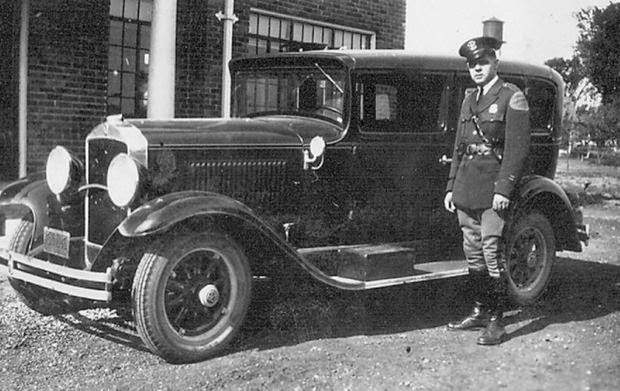
In Carroll v. United States (1925) 267 U.S. 132 the Supreme Court upheld the search on the grounds that there was "a necessary difference between the search of a store, dwelling house or other structure in respect of which a proper official warrant readily may be obtained, and a search of a ship, motor boat, wagon or automobile, for contraband goods, where it is not practicable to secure a warrant because the vehicle can be quickly moved..." The Fourth Amendment, the Court said, was to be construed "in a manner which will conserve public interests as well as the interests and rights of individual citizens." So long as the police had probable cause for their search and seizure, the procurement of a warrant was not necessary.
Justice McReynolds, a Presbyterian teetotaler, anti-smoker and arch-conservative, dissented.
McReynolds denied that there was any legal basis for exempting vehicles from the warrant requirement and denied that the previously attempted sting gave rise to probable cause two months later. He reminded the majority that "If persons can be restrained of their liberty, and assaulted and imprisoned, under such circumstances, without complaint or warrant, then there is no limit to the power of a police officer" and nothing is left of the Fourth Amendment.
Carroll was the seminal case in the subsequent eighty year shredding of the Fourth Amendment by the Supreme Court. Like any truly seminal case, all the festering poison that ultimately hatched out lay in Carroll's poisonous kernel.
The poison was a compound of three toxic concepts: (1) a spurious distinction between persons and places; (2) the substitution of suspicion for probable cause; and, most fundamentally, (3) the notion that the Fourth Amendment could be recalculated ad hoc so as to account for Government interests. Over the next eighty years, in a plethora of factual scenarios, the Court would repeatedly use these toxic concepts to whittle the Fourth Amendment down to the size and consistency of a chewed-on tooth pick.
On 15 December 1921, Federal Prohibition Agents were patrolling the highway between Grand Rapids and Detroit when they noticed the Carroll brothers' car headed in the opposite direction. Two months earlier, federal agents had unsuccessfully attempted to purchase contraband liquor from the brothers who were suspected of bootlegging. The agents u-turned, stopped the car and arrested John Carroll for violating the Volstead Act. During a search following the arrest, the agents seized 68 bottles of whiskey.
In Carroll v. United States (1925) 267 U.S. 132 the Supreme Court upheld the search on the grounds that there was "a necessary difference between the search of a store, dwelling house or other structure in respect of which a proper official warrant readily may be obtained, and a search of a ship, motor boat, wagon or automobile, for contraband goods, where it is not practicable to secure a warrant because the vehicle can be quickly moved..." The Fourth Amendment, the Court said, was to be construed "in a manner which will conserve public interests as well as the interests and rights of individual citizens." So long as the police had probable cause for their search and seizure, the procurement of a warrant was not necessary.
Justice McReynolds, a Presbyterian teetotaler, anti-smoker and arch-conservative, dissented.
"The damnable character of the 'bootlegger's' business should not close our eyes to the mischief which will surely follow any attempt to destroy it by unwarranted methods. 'To press forward to a great principle by breaking through every other great principle that stands in the way of its establishment; . . . to procure an imminent good by means that are unlawful, is as little consonant to private morality as to public justice'."
McReynolds denied that there was any legal basis for exempting vehicles from the warrant requirement and denied that the previously attempted sting gave rise to probable cause two months later. He reminded the majority that "If persons can be restrained of their liberty, and assaulted and imprisoned, under such circumstances, without complaint or warrant, then there is no limit to the power of a police officer" and nothing is left of the Fourth Amendment.
Carroll was the seminal case in the subsequent eighty year shredding of the Fourth Amendment by the Supreme Court. Like any truly seminal case, all the festering poison that ultimately hatched out lay in Carroll's poisonous kernel.
The poison was a compound of three toxic concepts: (1) a spurious distinction between persons and places; (2) the substitution of suspicion for probable cause; and, most fundamentally, (3) the notion that the Fourth Amendment could be recalculated ad hoc so as to account for Government interests. Over the next eighty years, in a plethora of factual scenarios, the Court would repeatedly use these toxic concepts to whittle the Fourth Amendment down to the size and consistency of a chewed-on tooth pick.
Dispensing with Warrants
Carroll's distinction between buildings and vehicles was sucked by spurious analogy from the special powers of customs agents to search vehicles and baggage at ports of entry. However, customs searches are sui generis. No authority has ever held that customs agents require warrants or even probable cause to search bags or vehicles at entry points into the country. But a rule for what takes place at ports of entry cannot set the standard for what takes place in the interior of the country; for, if it did, then the Fourth Amendment would be utterly meaningless since anyone could be searched not only without a warrant but also without any specific probable cause.
Carroll's analogy was not only spurious, it was also an historical anathema because one of the principle grievances which triggered the American Revolution had been the use of general customs warrants to stop vehicles, search homes, interrogate persons and seize contraband and uncustomed goods, wherever found, without limitation and without specific cause.
As an accepted mode of construction, the Constitution has always been interpreted in light of English and Colonial law existing at the time it was drafted since this was the legal and political context in which various words and phrases were used. At the time of its adoption and continuously since, the only exception to the Warrant Requirement, apart from customs searches, was the exigent circumstance of an observed (not merely suspected) felony being committed in an officer's presence.
The Founding Fathers knew all about contraband rum runners like John Hancock. They were not Panglosian morons. Nevertheless, they made the prior obtaining of a judicially reviewed and issued warrant a pre-requisite for any search or seizure. They did so because, without the warrant requirement, there is no limit to the power of a police officer. The fact that police conduct may be disapproved post hoc does not mean that it is curtailed a priori.
After many permutations over the course of the century, Carroll's first toxic concept reached its poisonous fruition in Segura v. United States (1984) 468 U.S. 796, in which the Court held that a non-moving dwelling may be seized by the police until they are able to secure a warrant for its search.
In that case, federal drug enforcement agents had probable cause to believe that Segura was selling drugs out of his home. They arrested him outside his apartment which they then entered and, without touching anything, "froze" the premises from within until the following day when they obtained a warrant authorizing further search and seizure.
The Court reasoned that, although a house, unlike a vehicle, cannot disappear into back roads and by-ways, evidence within it can be destroyed and is, in that sense, just as "movable" as a car. In this regard, Americans will be pleased to learn that there is a vast compendium of constitutional jurisprudence on flushing toilets. The compendium reached its culmination in Segura which held "that securing a dwelling, on the basis of probable cause, to prevent the destruction or removal of evidence while a search warrant is being sought is not itself an unreasonable seizure of either the dwelling or its contents."
In so holding, Segura dispensed with any vestigial and bothersome notions concerning "exigent circumstances" such as facts giving rise to a reasonable belief that evidence was about to be imminently flushed or destroyed. The Court's majority explicitly accepted that no exigent circumstances had existed at the time the police entered the apartment. Segura's "freeze and seize" rule was justified by the need to prevent merely the possible, hypothetical, destruction or removal of evidence. Of course any evidence anywhere can possibly be destroyed or removed and, on that basis, any building can be secured and seized without a warrant, just as the Carroll brother's car.
Lowering the Bar
The second of Carroll's poisons concerned the meaning of probable cause.
Unlike their Continental counterparts, English and American jurists tend to cultivate ambiguity rather than precision. As a result there has never been a very precise or clear treatment of the difference between hunch, suspicion and probable or reasonable cause. The ultimate result is that the fundamentally effective requirement for a search ("probable cause") has remained a question of judicial gut feeling no matter how much the courts bandy about words like "articulable" "reasonable" "objective" and, most currently, "objective reasonableness" -- as distinct (one supposes) from "idiosyncratic reasonableness."
(If judges actually thought about what they wrote, they might actually be embarrassed.)
To facilitate understanding of Carroll's second poison, it will help to divide an imagined line into degrees of proof,
hunch---suspicion---probable cause--proof beyond doubt
A hunch is typically thought of as a "naked belief" that someone is up to something without any articulable reason to support the conclusion. Because "up to something" could be anything it points to nothing specific either guilty or innocent. The "decision" that a guilty-something is involved is a logical toss-up.
In actuality, however, hunches do not arise out of the blue. Both "inchoate hunches" and "reasonable suspicions" are based on generalizations and pre-judgements drawn from experiences. When a patrol officer pulls over a brand new car being driven by three black youths, he is not acting whimsically but on the coupling together of typically true generalizations; viz, that juvenile delinquents often act in concert, that blacks tend to be poor, that shiny new cars are expensive. There is a chance -- some possibility -- that the car is being stolen. At the same time, however, there is no fact from which it can be inferred that this car is being stolen at this time by these youths. The only thing shown is that the "suspects" fit into a conflux of very broad generalizations, sometimes called a "profile." Matching a profile raises a possibility which is not entirely arbitrary but which lacks any degree of probability (or, as the courts often say, “specificity”). There is simply no basis on which to say that the seeming inference of guilt is more true than not.
If however there had been a report that two or three black youths were recently seen in the vicinity looking into parked cars, then those facts, in those proximate circumstances, would give rise to a more specific possibility of criminality. The inference which could be drawn on these facts is still a mere possibility but it is one which is anchored to some specific fact more concrete than the coupling of abstract generalizations. This situation -- generalizations which have a toe-hold in actuality -- is what judges refer to as an "articulable" or "reasonable" suspicion.
The distinction between a "hunch" and a "suspicion" is so tenuous as to be almost meaningless. In both cases we are dealing with mere possibilities or (at most) extremely low probabilities. Nevertheless, it is a distinction the Supreme Court has drawn and it is on that basis that it has been able to speak of an "articulable" or "reasonable" suspicion as if this were something substantial and more significant than a toe-hold on the edge of probabilities.
Probable cause on the other hand involves such a calculus of inferences from specific facts that passes from possibilities into specific probabilities -- not just a general or abstract probability based on actuarial data but a focused probability concerning a particular person, place, object and crime. In the example given, a report that a car of matching or very similar type owned by a silver haired old lady was recently reported stolen would make it more probable than not that this car being driven by three black juveniles was stolen.
Such a probability would not end the matter, as there might always be some explanation or defence as to why these three men were in that car. But the likelihood of criminality would be enough to warrant an arrest and trial, at which the charge could be proved beyond a reasonable doubt.
At the time the Fourth Amendment was drafted, the accepted meaning of "probable" was: "Likely; having more evidence than the contrary, or evidence which inclines the mind to belief, but leaves some room for doubt. That is accounted probable, which has better arguments producible for it than can be brought against it." (See e.g., Webster's Dictionary (1828).) Thus, traditionally speaking, probable cause fell into the ambit of preponderating probabilities and was little different from the standard of guilt in civil cases. What is of note is not that this is a lesser standard than that required for criminal proof, but rather that it is still, nevertheless, a standard of guilt.
With these definitions in mind, it can be seen that the majority in Carroll set a very low bar for what was said to be probable cause. The prohibition agents had more than a hunch based on the general fact that the road in question was known to be frequently travelled by bootleggers. Two months previous John Carroll had agreed to supply the agents with liquor although he never followed through with the deal. There was certainly a somewhat specific possibility that on the date in question the Carroll brothers were running contraband. But as McReynolds correctly pointed out, there was no demonstrated probability that they were doing so at the time they were stopped. Assuming that the Carroll brothers were bootleggers that fact did not mean that everywhere they drove they were spiriting whiskey from one place to another. The arguments for and against there being whiskey under the back seat were in equipoise. In the end, Carroll allowed a detention and arrest on a bare suspicion.
Unlike Carroll's legal rule concerning a warrant exception for vehicles, its factual finding of probable cause was case-specific and did not -- on the surface -- announce any new standard of good cause for an arrest or search. Even so, its finding sounded an ominous gong as to how low the Court was prepared to go in order to "conserve public interests" as they put it. McReynolds was alive to what the majority was down to: "Any law which would place the keeping and safe conduct of another in the hands of [the police] or upon mere suspicion of felony, would be most oppressive and unjust, and destroy all the rights which our Constitution guarantees."
How destructive was made clear, 43 years later, in Terry v. Ohio (1968) 392 U.S. 1 which held that the police needed only a "reasonable suspicion" to stop and frisk people they suspected of possibly engaging in criminality.
In Terry, the police officer saw three black men hanging around on a street corner for 30 minutes in the afternoon, repeatedly looking into store windows and evidently not waiting for anyone. Deciding that they were casing the store, the officer approached the men, asked them their names and patted them down for weapons, at which point the officer felt and seized a revolver in Terry's pant pocket. Terry was charged and convicted -- not of attempted theft -- but of carrying a concealed weapon.
The Court held that the seizure of Terry's weapon was lawful because the Fourth Amendment allowed a "cursory" search for weapons where the officer "has reason to believe that he is dealing with an armed and dangerous individual, regardless of whether he has probable cause to arrest the individual for a crime." In this case, the "specific reasonable inferences" the officer was "entitled to draw from the facts in light of his experience" were that the men appeared to be casing the store and were contemplating a robbery which "it is reasonable to assume, would be likely to involve the use of weapons." In plain English, a pat-down for weapons could be based on a hunch.
Strictly speaking, the officer's initial approach and momentary detention for questioning was not at issue in Terry. But since a frisk for weapons cannot take place without an antecedent stop, the Court felt obliged to address that issue as well. In this regard, the Court explained that "[w]henever a police officer accosts an individual and restrains his freedom to walk away, he has "seized" that person. ... It is a serious intrusion ... and it is not to be undertaken lightly.... In justifying the particular intrusion, the police officer must be able to point to specific and articulable facts which, taken together with rational inferences from those facts, reasonably warrant that intrusion."
Courts and lawyers were quick to realize that Terry had in fact re-written the Fourth Amendment, formally and explicitly replacing the probable cause standard with a lower standard of reasonable suspicion applicable to vehicles and persons. The formula was given explicit imprimatur, in Brown v Texas (1979) 443 U.S. 47, 51 which held that to detain a person for questioning officers must "have a reasonable suspicion, based on objective facts, that the individual is involved in criminal activity."
The formula sounds appealing until one realizes how significant a retreat from the probable cause standard is involved. Despite the palaver about articulable specificity, Terry's reasonable suspicion standard was not only well below the Fourth Amendment's probable cause threshold, it was also vague in that the phrase "is involved in" was open-ended. How open-ended was illustrated by Sokolow v. United States (1989) 490 U.S. 1 in which the Supreme Court held that a "criminal profile" constituted a reasonable suspicion even absent any objective indicia of present criminality.
In that case, Sokolow had booked a round trip flight from Honolulu to Miami including a two-day layover before returning. He paid for the ticket in cash and travelled under a name which was different from the one under which his home phone was listed. He was dressed in a black jumpsuit, wore gold jewelry and traveled with carry on bags only. He was said to appear nervous. On arrival in Miami, DEA agents "grabbed" him by the arm and escorted him into an office where his bags were searched.
Dissenting, Justice Brennan pointed out that, even under the Terry standard, "before detaining an individual, law enforcement officers must reasonably suspect that he is engaged in, or poised to commit, a criminal act at that moment." [Original emphasis.] Nothing in the alleged profile-facts supported an inference that Sokoloff was then and there transporting drugs.
The Court's majority was indifferent. With remarkable candour they stated:
"The Fourth Amendment requires 'some minimal level of objective justification' for making the stop. ... That level of suspicion is considerably less than proof of wrongdoing by a preponderance of the evidence. We have held that probable cause means "a fair probability that contraband or evidence of a crime will be found," and the level of suspicion required for a Terry stop is obviously less demanding than that for probable cause."
Fitting a profile is simply another way of squeezing rain from a cloud. A "profile" may indicate some possibility that a person "is involved" in criminality as a propensity or practice in the way that lawyers "are involved" in law. That is not the same as saying that the involvement is occurring at a particular moment in time. The rest is pot-luck.
The majority were equally cavalier with the scope of Sokoloff's "stop". Part of Terry's rationale for lowering the causal bar was that the "intrusion" of a brief stop for cursory questioning, while technically a "seizure" of the person, was a minimal detention of short duration. There was nothing minimal about Sokolow's seizure. Far from being a hands-off investigative questioning, he was "grabbed" by the arm and "escorted" into the DEA sub-station. By any reasonable measure he had been arrested de facto, albeit without probable cause. There was little the court's majority could do with this fact except ignore it.
A False Balance
But to ignore Sokoloff’s seizure was to ignore precisely what the Fourth Amendment prohibits. This, in turn, revealed Carroll's third poison; namely, its dictum that the Fourth Amendment should be interpreted in a manner which "will conserve public interests as well as the interests and rights of individual citizens."
As of the time Terry was decided this dictum had evolved into an accepted formula that the legality of any search or seizure depended on "a balance between the public interest and the individual's right to personal security free from arbitrary interference by law officers." (See United States v. Brignonie-Price (1975) 422 U.S. 873, 878, citing Terry.)
Twenty years later, even the pretence of a balance was discarded. Sokolow reversed the lower court's ruling "because of its serious implications for the enforcement of the federal narcotics laws." (Id, at p. 7.) A constitutional limitation on the government's enforcement of its laws had been inverted into an imperative for the sake of law enforcement.
The metamorphosis of Carroll's dictum had far-reaching implications for constitutional jurisprudence in general, which are paradigmatically illustrated by its role in the destruction of the Fourth Amendment.
In 1925, it was still too early in the day for the Court to speak in the functionalist lingo of "balancing tests" which later proliferated like weeds throughout the Garden of the Law and stupefied the minds of credulous lawyers. These so-called "tests" were the spawn of a modernist ("sociological") jurisprudence the basic premise of which was that the Constitution needed to be "reinterpreted" in light of modern conditions. The view propounded was that law was a "tool of social engineering" which could be used to bring about desired socio-economic results and that law law needed to be "rationalized" so to explain away or weed out anachronisms which, supposedly, no longer made sense.
One such anachronism was the Fourth Amendment whose authors, it was said, never imagined the possibility of the modern automobile. The Amendment required reinterpretation in light of modern conditions the Founders could not possibly have anticipated.
This modernist condescension was pure drivel. The Constitution was drafted with human nature in mind, not on the assumed existence of a technological status quo. A mule-cart bearing contraband moonshine under a stack of hay, might move more slowly than a Model-T Ford with its breakneck speed of 40 mph, but it moved quickly enough to escape the issuance of a hand-scripted warrant served on horseback. What concerned the Drafters of the Constitution was the propensity of human governors to abuse their authority and power. From the corruption of Athenian democracy to the abuses of Crown customs agents, the Drafters had ample empirical evidence of the ways, means and devices of the human heart. On that basis, they made certain definitive decisions as to the extent and balance of individual rights, social needs and governmental powers. What Carroll's neat and fair-sounding formula failed to answer is: whose interests take precedence? The formula ignored that, in respect of fundamental rights, the balance was struck and set in the Bill of Rights.
Despite the pretence of scientific sounding lingo, the serious affect with which they are propounded and the gullibility with which they are swallowed, these balancing tests are devoid of any empirical objectivity -- they are not "tests" of any sort at all other than the sort of test which comes from holding finger to air. The "tests" are simply a masquerade for making law mean what it has to mean in order to promote some chosen concept of the public welfare.
German jurists in the 1920's called this approach teleological jurisprudence and it became the cornerstone of National Socialist law, the purpose of which was to provide an explanatory justification for the chosen needs and asserted well-being of the National Folk Community.
The same methodology was resorted to in the United States under the rubric of "outcome-determination" or sociological jurisprudence. The asserted social, economic or political purpose of any law, to promote this or that goal, would determine what the law had to mean and was. Legal analysis and argumentation was reduced to the scrounging up of "rationales" for the ultimate holding or desired result.
German "teleological jurisprudence" differed from American "sociological jurisprudence" in that, theoretically, there was no balance at all and no individual right could trump State imperatives. But, in practice, the distinction was, illusory. By debasing jurisprudence into a collection of "rationales" in favor of a result which is decided upon on some other basis, American law ceased being a prescriptive guidance and was reduced to a collection of post-hoc, sound-bytes.
By turning a guarantee of individual rights into a formula for "factoring in" governmental interests under the guise of an ever-renewable balance, Carroll allowed for a jurisprudence of evisceration. In either the German or American system, "law" becomes simply the howl that accompanies the exercise of state power.
The Carroll majority argued that the use of the word "reasonable" in the Amendment required it to balance personal and governmental interests in any given case. But as McReynolds argued, the Amendment's prohibition against "unreasonable" searches did not open to the door to any means a judge might think is "reasonable" if the means negated or circumvented the Warrant Requirement. Otherwise, the Amendment is rendered meaningless since the only thing it prescribes is improvisation.
The Howl Reaches Its Pitch
The Carroll court's dictum effected a fundamental perversion of Fourth Amendment jurisprudence. That article stood as a specified guarantee of personal rights, not as de jure vehicle for governmental policies. As the Court itself had stated ten years before,
"The effect of the Fourth Amendment is to put the courts of the United States and Federal officials, in the exercise of their power and authority, under limitations and restraints as to the exercise of such power and authority, and to forever secure the people, their persons, houses, papers and effects against all unreasonable searches and seizures under the guise of law. The efforts of the courts and their officials to bring the guilty to punishment, praiseworthy as they are, are not to be aided by the sacrifice of those great principles established by years of endeavor and suffering which have resulted in their embodiment in the fundamental law of the land." (Weeks v. United States (1914) 232 U.S. 383.)
As of 1968, when Terry was decided, the prohibition against unreasonable and unwarranted seizures was rebranded as a "Reasonable Search and Seizure Clause". (Sibron v. New York (1968) 392 U.S. 40,) In Sokolow, the fatal balance reached its final tip: in and of itself "serious implications for the enforcement of the federal narcotics laws" became the determining consideration for the outcome.
This fundamental shift was again made explicit in Florida v. Royer (1983) 460 U.S. 49 (1983) in which the Court ruled that "because of the public interest in suppressing illegal drug transactions and other serious crimes," a temporary detention for questioning in the case of an airport search may be justified without a showing of 'probable cause' if there is 'articulable suspicion' that a person has committed or is about to commit a crime." (See also Florida v. Rodriguez (1984) 469 U.S. 1 .)
What Sokolow, Royer and Rodriguez illustrated was that the "balancing test" is a pseudo matrix to fool people as to what is really going on. In neither case was any "balancing" involved, the Court simply ruled that the "public interest in suppressing ... crimes" over-rode the constitutional guarantee to be free from seizure absent warranted probable cause. It bears repeating that the Fourth Amendment was designed as nothing less than a limitation which applied to the "public interest" in suppressing crime. It was not meant to facilitate state power but to restrict it; and not just some times but all times whether convenient or not.
The judicial snake oil did not stop at pseudo balancing. It could hardly have been a coincidence that the Court had taken on cases which involved airport searches. The Court's opinions repeatedly referred to the search at issue as an "airport search" insinuating that some kind of "carefully delineated" aircraft safety exception was at issue. But the searches in these cases had nothing to do with aircraft safety. They were ordinary searches for drugs such as might occur on any street corner or highway. The airport was simple the mise en scene which had nothing to do with the real guts of the holding.
The justification for a “stop and frisk" — that it was a minimal intrusions which required minimal justifications — was a canard. The Court well understood that all criminal investigations proceed in sequential steps and that even a formal arrest begins with an initial "minimal" stop. The Terry decision gave birth to what became known as "escalating reasonable cause." From the starting point of an initial "momentary detention" for questioning, the police became adept at managing the situation so to generate more excuses for further intrusions and searches.
Thus, in Terry, the initial "rationale" for the stop (supposedly to ask the boys if they were contemplating a robbery) was in the next instant cast aside in favour of an assumed safety issue "reasonably requiring" a pat-down. The Court's opinion never once pointed to any "articulable fact" implicating a suspicion that Terry was armed. It would be the stuff of vaudeville, were the consequences to individual liberty not so severe. In reaching its result, the Terry Court ignored that never once had there been the least attempt to investigate anything. The officer simply approached Terry, asked his name, and when the latter mumbled a reply, spun him around and frisked his clothing and followed up with a full blown search. Similary in Sokolow, the majority again played the fool, pretending to ignore the patently obvious fact that the DEA agents planned and intended to arrest Sokolow for drug trafficking.
How far the Court would prostrate individual rights to government interests quickly ensued from Terry's distillation of Carroll's poison. Not only did the Court lower the bar from the probable cause standard to the toe-hold rule of reasonable suspicion, it then sought to prevent inquiry into the actual causes motivating the seizure. It did so by equivocating on the meaning of “motive.”
The facts in Sokolow pointed to a weakness in the Court's “balancing” in favour of governmental interests. In Sokolow, as most probably in Carroll, all signs were that the agents were acting on the basis of undisclosed information. The probable cause standard requires the government agents to 'fess up and reveal their true sources. The reasonable suspicion standard does not but rather allows them to concoct plausible sounding excuses, howsoever weak the beer might be.
Even so, a smart defense lawyer could exploit the facts to explore law enforcements true 'motives' — that is, the actual causes driving their decisions and conduct. In Sokolow's case, counsel might have seized on the fact that grabbing Sokolow's arm bespoke a purpose to arrest from the outset. From that point of departure counsel might then have sought to examine the agent on why he had resolved upon an arrest as opposed to engaging in momentary and hands-off questioning.
The Court needed to foreclose exploration into such "motives" and did so in Whren v. United States (1996) 517 U.S. 806 wherein it held that an officer's "subjective" motives for making a stop or arrest were not relevant under the Fourth Amendment so long as there was some "objective" basis, howsoever minimal, technical or "pretextual" (the Court's word) for the detention.
In Whren, the pretext for the stop, which ultimately uncovered drugs, was an un-signalled left-hand turn. That offence, the Court held, was necessary and sufficient for the stop. Far be it for Officers of the Law to ignore violations of the King's Traffic Law ... and far be it for the Court to inquire into ulterior subjective "motives." Of course, if probable cause “escalated” from the initial detention, one could hardly expect officers to ignore blatant evidence of possible criminality.
In conjuring up this doctrine of judicial blindness, the Court characterized the issue of "motives" as something involving personal hostilities or purposes -- such as racial bias or a desire to check out a pretty driver's legs. It was a blatant sophistry which equivocated on the meanings of “motive.” A “motive” is simply the driving force or effective “cause” of something. To inquire into “probable cause” is to ask a question about motives or motivating factors; i.e., what facts caused the police to believe criminality was afoot. In Whren, the issue of "motives" was arbitrarily cast as one involving irrelevant subjective and idiocyncratic motivations, even though the Court well understood that the real motive at issue was the undercover information driving the official and collective investigation.
With appalling brutality, Whren simply pulled out the word "subjective" to forestall meaningful inquiry into actual probable cause. It stands for the proposition, that whatever else law enforcement knows and may in fact act upon, they need not disclose it, ever, so long as they can come up with some plausible sounding pretext -- a "profile" in the case of Sokolow or a violation of traffic law as in Whren.
In other words, the probable cause standard as a true and thorough examination of what actual drove police conduct ceases to have any importance and is simply shunted aside, in favor of something that might well be labelled spurious probable cause or, worse yet, spurious reasonable suspicion. Whatever the police can “objectively” concoct, it will be swallowed whole by the reviewing court.
This year, the black cat leaped from the bag. The recent disclosure that the National Security Agency has been funneling surveillance data to the D.E.A. and local law enforcement on condition that the police hide the source with some "parallel construction" of reasonable cause will come as no surprise to defence lawyers.
It could hardly come as a surprise to the Court which, as far back as 1979, observed that, "In reviewing the factors that led the agents to stop and question the respondent, it is important to recall that a trained law enforcement agent may be "able to perceive and articulate meaning in given conduct which would be wholly innocent to the untrained observer." (Brown v. Texas, supra at 52.)
The Court's recall was utterly disingenuous. The constitutional standard of probable cause (and even of reasonable suspicion) presupposes review, at some point, by an independent judicial officer -- that is, by a person not endowed with the extra-perceptory faculties of trained agents but with a mere ordinary human capacity for orderly and inferential logic. To say that something must be "reasonable" is at least to say that it is capable, without more, of being understood and assented to be rational beings. Once it is accepted that a witness has special extra-perceptory abilities, we have sunk back into the fog of spectral evidence, where uniquely endowed witnesses point to hovering apparitions unseen by anyone else. At that point the Court might as well have hauled out Rev. Cotton Mather's epic jurisprudential tome on The Wonders of the Invisible World (Salem, Mass., 1693).
Consensual Encounters and Exposures
Two more pieces were required to complete the farce. The first of these was the rule of "consensual encounters." In a series of cases promulgated in the 1980's and 1990's, the Court lowered the bar even beneath Terry and ruled that a police officer need not have any reason at all to approach and talk with a person, so long as there was no detention and the person so approached was "free to go." (United States v. Mendenhall (1980) 446 U.S. 544.) Nothing in the Constitution, the Court said, forbade a police officer from approaching someone to talk and if the person approached "decided" to stay and chat, about fishing or anything else, that was his free and voluntary decision outside the ambit of Fourth Amendment scrutiny. In fact, a person is "constitutionally" free to go and to "end" the encounter, even when the police hover over him as he is seated in a bus against the window. (Florida v. Bostick (1991) 501 U.S. 429.)
Moreover, since "subjective motives" are irrelevant there is no need to ask why the officer is wasting taxpayer money talking up fishing; and, if in the course of fishing chat, the person should happen to disclose something suspicious sounding, the officer can hardly be expected to ignore it and cannot be blamed for following up on possible criminality.
Characterizing encounters between people and state agents as "consensual" was the ultimate cheek but that did not stop lower courts from holding that official "requests" to produce identification, to search a vehicle, or to enter a home were not "commands" and therefore that the ensuing intrusion had been "consensual."
Mendenhall and Bostick were truly vicious pieces of work. An officer in uniform is presumed to be acting in an on official capacity on state business. That is what the uniform represents. He is not hired to talk about fishing but rather to represent the State and to discharge the State's business. There is nothing "consensual" about the encounter because citizens are required to respond to exercises of official authority. Is a motorist entitled to ignore flashing coloured lights in his rear view mirror on the assumption that the patrol officer is merely looking for someone to chat with about fishing?
Older caselaw required officers to have probable cause before accosting a citizen. They did so in recognition that the "right" to tell the government to mind its own business and go to hell was one that could only be vindicated in a court of law; otherwise self-recourse to the right would lead to pandemonium. Under, Mendenhall and Bostick a citizen can exert his right to ignore the officers and go about his business but the police are equally entitled to tazer him or shoot him in the back for "evading" or "non-compliance" with what they unilaterally decide was an "official request."
Akin to consensual encounters was the doctrine of "voluntary exposure" which the Court used to invert our concepts of public and private space.
In 1890 professors Warren and Brandeis wrote a short but important article on privacy law in which they anlogised the right of privacy to a fee simple absolute ownership interest in land. (The Right to Privacy, (1890) 4 Harvard Law Review 193.) Just as a person owns a 100 percent absolute interest in land, except and to the extent he might give it away, so too a person has, by default, a 100 percent privacy interest except and to the extent he discloses or exposes himself to others. The article was intended for copyright purposes and to protect people from snooping yellow journalism. However, in Smith v. Maryland (1979) 442 U.S. 735 and California v. Greenwood (1988) 486 U.S. 35, (1988) 486 U.S. 35, the Court adopted the theory to criminal purposes, holding that a person retained no privacy interests in what he had voluntarily exposed to others.
In Smith the Court held that dialed telephone numbers were "conveyed" to the telephone company and could no longer be deemed private. In Greenwood, the Court followed up and declared that no privacy interests were retained in garbage bags deposited on the curb for pickup and thus "exposed to public view". The police were free to snoop through it if they wished.
Such sophistries could not be deduced from Brandeis and Warren. Their article made clear that, unlike virginity, privacy could be parted with by degrees for specific purposes. If privacy could be parted with by degrees, it necessarily followed that it could be retained in degrees. A telephone company maintains dialing history for billing purposes in confidence. Likewise garbage is "conveyed" to garbagemen only as needed for it to be taken to a landfill. In fact, as the dissent in Greenwood pointed out, the garbage inside the the bag is not "exposed" at all. It is not "abandoned" to the public or strewn about for all to see.
At bottom the Court's consensual exposure doctrine was based on a sophistry which equated being seen in public with being followed, stalked or snooped. It is true that a person who ventures out into public "exposes" himself to the public. People who talk in public likewise risk being overheard. But they do so to a public which is understood to be indifferent. These exposures do not imply a consent to be stripped naked by any passerby or to be kept under ongoing surveillance by police with notebooks in hand.
The result of Smith and Greenwood was an inversion of public and private space in which the only place where one is free from government surveillance is locked up at home and public free-space is turned into vast, surveilled prison yard. As Brennan stated, "The American society with which I am familiar 'chooses to dwell in reasonable security and freedom from surveillance,' (Greenwood, supra, at p. 56.)
This then was the general state of Fourth Amendment jurisprudence prior to 9/11 and the Patriot Act. You can be stopped, frisked, questioned and arrested for riding a bicycle without identification or for fitting a suspicious profile or for anything else amounting to a so-called reasonable suspicion. Your car can be stopped and searched from top to bottom on any mere pretext. Anything you expose in anyway is can be monitored, recorded and used against you in a court of law. Your house can be "temporarily seized" pending the issuance of a warrant for its permanent seizure and a plethora of exigencies (such as saving a cat in distress or even a suspiciously open door) can justify intruding into the house without a warrant on an emergency basis.
It would be impossible to compress into a short article all the myriad excuses the Court has used to eviscerate the Fourth Amendment and, in fact, these technicalities are not politically important. The salient fact is that, by means of linguistic devices, the Court has shifted the context and focus of the Fourth Amendment so as to lower the bar for any seizure and so as to expand the scope of any search.
Over a 75 year period the Fourth Amendment was inverted from a protection of people against government into a collection of excuses in favor of governmental interests. The right of people to be secure in their persons, houses and effects has been, in the Court's own words, inverted into a clause which enshrines state power to conduct searches and seizures. ( Sibron v. New York, supra, 392 U.S. 40)
The Law’s Erlkonig
Taking a long view, it can be seen that the evisceration of the Fourth Amendment was accomplished in the name of a some exalted principle: a crusade against alcohol, against drugs and, now, against terrorism. What these "evils" have in common is that they are amorphous. They lurk anywhere and anyone is a "potential" rum runner, drug mule or bomb carrier. Everyone is a fortiori suspect.
Traditional crimes define more or less specific and distinguishable conduct; for example, "breaking and entering" a dwelling, or "taking and carrying away" property of another, or "intercourse without consent." While these forms of conduct can arise in myriad variations, as forms, they are discrete and distinguishable.
In contrast, drug and rum running are "formless crimes" because they can occur under cover of myriad innocent variations, such as "sitting on a bus" or "talking to a bystander." Terrorism is similarly formless in that it can be carried out by any ordinary-looking person and involve almost any kind of violent criminal conduct.
Indeed, in 2008 CIA Chief, Mike McConnell told Congress that Al Qaeda had improved its ability to recruit operatives capable of "blending" into American society and attacking domestic targets. The only thing moronic about this statement was that, by definition, that is precisely the “capacity” terrorists have. Did Congress, or for that matter McConnell, really think that terrorists sneak about wearing identifying insignia? The positing of a “terrorist threat” ipso facto puts the entire country under suspicion.
This is not to argue that the Government cannot outlaw contraband or terrorism. It is only to point out that the Constitution rightly imposes limitations on how such crimes are detected and prosecuted. It is one thing to arrest a drug courier on specific information and probable cause that he is presently engaged in drug-running. Once the bar is lowered to a mere suspicion of possible criminality then, precisely because the crime is formless any conduct howsoever “seemingly innocent” becomes suspicious or, as is typically said, "potentially criminal."
For years, police have resorted to double-talk and passive constructs to slip “potential cause” past supposedly unsuspecting judges. They have resorted to gobbledegook like, “the suspect was known to have links to potential criminal activity...” Along with blendable terrorists, this amorphous non-sense has confused thought and penetrated even the highest reaches of journalism, as for instance when the New York Times reported “Potential Suspect in Robbery of Justice Breyer.”
What in the world is “seeming innocence” seeing as things are usually what they seem to be? What in the world is a "potential suspect," given that a suspect is a person who imaginably might be engaged in something? Such terms and phrases are mere shadows and, as such, they cast darkness over all of society. They conjure up an unseen evil which hovers behind and over all making everything which is seemingly innocent potentially suspect.
This is precisely the inversion that takes place in totalitarian societies where the question is not what is prohibited but what is allowed; not who is guilty, but who is innocent. Worse yet, (seeming) innocence bespeaks (potential) guilt.
The Fourth Amendment was designed to prevent just that kind of inversion. Society is premised on trust and friendship. Accordingly, the Fourth Amendment demands specificity and cause in order to suspend that premise in any particular case. It requires the existence of some distinguishable criminal act and was specifically designed to prevent rummaging, rampaging hunts for some "potential crime" occurring under apparently innocent activity.
A doctrine or culture of suspicion is a Manichean hysteria which spooks itself with the conviction of some ever-present evil lurking in a world of darkness and which, as a result, converts society into a mighty fortress turned against itself.
Unfortunately political diseases, like physiological ones, develop over time from bad habits and abuse. When they at last break out it is usually too late to remedy the ill-effects except by drastic means which are near as bad as the disease itself.
As a result no one in Washington — and certainly no one on the Court -- is talking about resurrecting the Warrant Clause requirement. Rather the point of departure for the public debate (such as it is) is that warrants can issue for a class of activities as to which Government has a general "right" to search by default.
Likewise, no one is proposing to reinstate the probable cause standard. Instead they are debating and tweaking the non-standard of reasonable suspicion, which itself has been interpreted as allowing dragnet searches for potential criminals or terrorists -- that is, for persons as to whom no specific information of criminality exists but who might (as a mere possibility) be involved in terrorism or crime.
The Founders of the Republic understood that the Constitution was a solemn covenant which fundamentally shaped how we would be and what we were about. The Bill of Rights enshrined a political morality which was intended to restrain the devices expediency. The Fourth Amendment did not prescribe a kazoo of reasonable pretexts; it established what the Constitution deemed reasonable and demanded.
In another context Justices Sutherland and McReynolds warned that “[e]very journey to a forbidden end begins with the first step." (Carter v. Carter Coal Co. (1936) 298 U.S. 238.) They would have understood Samuel's admonishment to the Israelites who rejected their Covenant and cried, "Give us a King to rule over us; so that our king may judge us, and go out before us, and fight our battles!" Samuel showed them the ways of the king that would reign over them and warned them saying, "Ye shall then cry out because of your king which ye shall have chosen but the Lord will not hear you in that day." (1 Samuel 8.)
The forbidden end has been reached and we will not be heard.
 |
| Justice Mc Reynolds |
©JustinLaw, 2013
Subscribe to:
Posts (Atom)